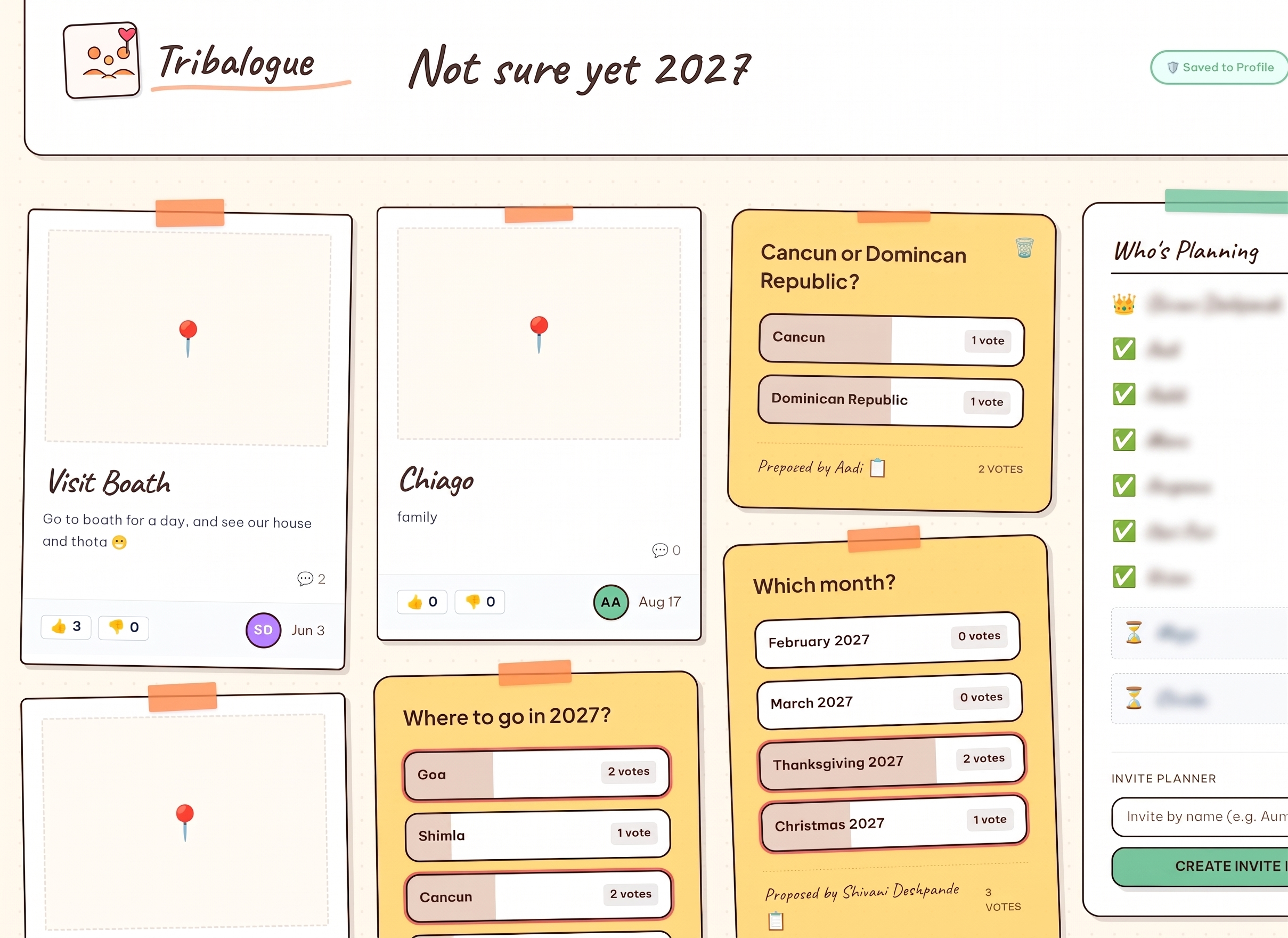
Tribalogue
Consensus vacation planning for families and social groups, built with a playful Stitch-crafted interface.
Tribalogue🔗
Inspiration🔗
The inspiration for Tribalogue struck right after I returned from a family trip to Chicago. We were all reminiscing about one of the best family vacations we had some 20 years ago, and were trying to think about where we could go next.
I had always imagined building a way for my family and friends to plan our trips in shared setting, and given that I was newly in the bread line, I had nothing but a head full of ideas and pockets full of AI credits, so I wanted to see how long it would take me to come up with something and get it on the internets
Stitch🔗
One of the last things I was privy to at my job was a set of conversations around how “real companies” in the “real world” use AI, especially those who hawk it for their work. The Google rep gave a contrived example where he started a fictional hotel company and proceeded to explain how he would use Stitch to build the design and Gemini to build a marketing website.
I do not think that architects at Google are starting fictional hotel companies every day so I didn’t think that was an example of a “real world” usage of anything, but I did get to learn about Stitch, which is actually a really great product for building a design from scratch.
I went through a number of iterations of on Stitch until I landed on the scrapbook design that I ultimately went with. Stitch lets you export a DESIGN.md file and has an MCP server to connect with your harness for pulling assets from the Stitch project down into your codebase. Also, let me say that Gemini is really very good at creating design assets.
Constraints of My Own Making🔗
Building a CRUD app is a pretty straightforward thing that I’ve probably done 50 times over. In order to make it enjoyable, I wanted to throw in a few wrenches.
A. Cloudflare on the Cheap🔗
Given that I was newly unemployed, I wanted to build something that would be easy to host and light on the wallet.
I picked Cloudflare’s very generous free tier for Workers and Pages, and decided that it should be a cacheable SPA that could be served as much as possible from the edge. Keeping it a NextJS app also meant I could check out and play around with vinext.
B. Nominal Identity with WebAuthn🔗
I don’t want to store things in databases if I can help it. I certainly don’t want to keep track of usernames and passwords and the like. But having no way to identify people really kills the social aspects of a social experience.
I worked on implementing WebAuthn with passkeys and keeping the least amount of information around each board to limit the needed storage for each board. The results, if nothing else, work. I do wish WebAuthn gave you a way to forward a nick or an alias, though.
To Be Done🔗
1. Web Prompt API🔗
I really believe that Local LLMs and SLMs are a big part of the future. The increasing capabilities of these models coupled with the decreasing size is making Moore’s law seem like a zombie crawl. Chrome already ships with Gemini Nano and some amount of compute needs to be handled by devices or its wasted economics.
I’m using tribalogue to explore image generation, summarization, even MCP and A2A integration etc. in a privacy-safe way